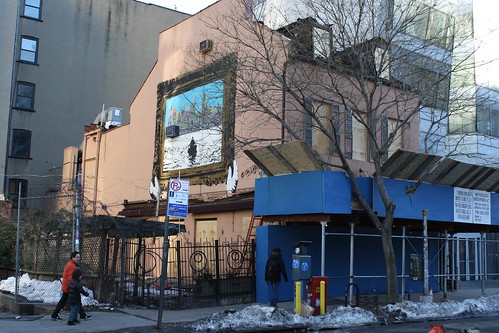


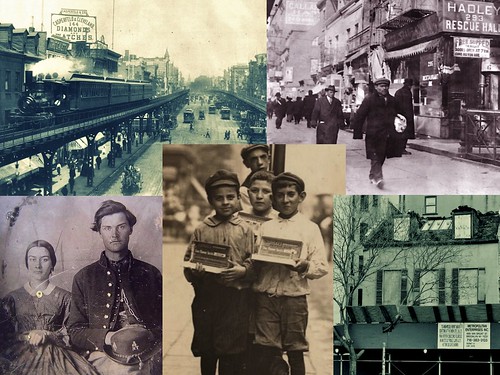
 Clockwise from top left: (1.) Bowery Elevated Train, circa 1896; (2.) Bowery near Bleecker, circa 1915; (3.) 35 Cooper Square in February this year; (4.) Boys on the Bowery selling chewing gum, 1910; (5.) A Union enlistee of the New York 86th Regiment and his betrothed, circa 1861. All images courtesy Library of Congress, except (3.) lower right, photo illustration by Tim Milk
Local historian Tim Milk recalls dark episodes which never quite extinguished the charm of 35 Cooper Square.
They could hardly believe the fellow, wanting to go back to his regiment. Especially considering what he had seen: the rout of the Union at the bloody battle of Bull Run. There, the heroic Lieutenant John S. Whyte, who had refused to leave his wounded commander, fell into Confederate hands. But in a recent prisoner of war exchange, he was returned home to his kith and kin in New York.
But he did not wish to retire with honors. Indeed, he was keen to “return to the fight,” he said.
And so his pals shook their heads and dragged him down to the Marshall House, a tavern at 391 Bowery, an address we know today as 35 Cooper Square. There they presented him with a sword and a sash in an affair both touching and festive. After a grand hurrah, the champagne flowed like a river long into that night of March the 21st, 1862.
This I found in the archives of the New York Times, in a curious walk down that ancient lane, the Bowery. From out of each door came someone with a tale to tell which, except for these old papers, and poor relics like 35 Cooper Square, would otherwise have vanished, lost in time.
“Time,” Stephen Hawking once said, “…whatever that is.” Even he doesn’t pretend to know. As the so-called future, it is but a mere concept. As the past, it holds everything that has ever happened, and leads all the way back to eternity. There it washes up on distant shores for no apparent reason, except perhaps for our return. Read more…