

_FEATURED

Local Legends | ‘Monk’ Eastman

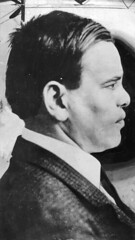
Monk EastmanCourtesy of Rose Keefe. ‘Monk’ Eastman.

Eleven days ago, the arrest of nearly 125 mobsters reacquainted many to the fact that the mob still has life outside of the occasional H.B.O. series.  Federal officials labeled the bust “the largest mob roundup in F.B.I. history,” and once the media got ahold of the accused’s food-centric monikers – here’s lookin’ at you “Junior Lollipops” – curiosity ensued.

Americans have a longstanding fascination with the mob. As Eric Ferrara, director of the Lower East Side History Project puts it, “The outlaw is timeless. They have a certain brazen quality that people tend to admire.”

In light of recent gangster coverage, The Local thought it might be the perfect time to take a look at one of the East Village’s own “brazen” outlaws – one with whom you may not even be acquainted.

Before Al Capone, before Luciano, and definitely before “Tony Bagels,” the gangster to be feared and admired was “Monk” Eastman.

Born Edward Eastman in 1873, the mobster known as “Monk” was a frightening figure to behold. As the historian Herbert Asbury described, “He began life with a bullet-shaped head.” He was broken-nosed, bull-necked, and had a face scarred from smallpox and a lifetime of brawling.

In the 1890’s, the Lower East Side was a warren of disease-friendly tenements for the immigrated poor and, by all accounts, its streets were a breeding ground for pickpockets, thugs, and slummers of all stripes.

It was on these same mean streets that Mr. Eastman carved out a reputation as a neighborhood tough and eventually recruited his own gang: the Eastmans.
Read more…

Demand Spikes At Area Soup Kitchens

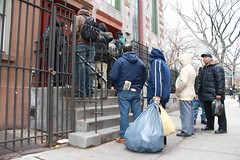
Lunch Line at Trinity Lower East Side Liz Wagner Homeless and needy line up for free lunch outside Trinity Lower East Side Lutheran Parish on East Ninth Street and Avenue B. The pastor of the church says that its soup kitchen is being stretched thin by an uptick in need.

Joey Ortiz has been coming to Trinity Lower East Side Parish on Ninth Street and Avenue B for a hot lunch nearly every weekday for two years. He’s been struggling to make ends meet since he lost his job working in an optometrist’s office at the SUNY Downstate Medical Center in Brooklyn. One recent afternoon, he stood in the soup kitchen line for 20 minutes with dozens of people in front of and behind him. While Mr. Ortiz says he has never been denied a meal, he wonders how long the church will be able to feed an increasing number of hungry New Yorkers.

“You see how many people,” Mr. Ortiz said pointing to the growing line. “There is not enough food. There is more need.”

Pastor Phil Trzynka says Trinity’s nonprofit, Services and Food for the Homeless, Inc., is seeing more needy people now than ever before, but can still meet the demand. He says the soup kitchen, which provides lunches Monday through Friday, serves 235 meals a day — up from 150 meals five years ago. But Mr. Trzynka also says the church’s budget is $30,000 less than what it was last year because government grant money and individual donations are down. He says the Lutheran parish which serves all denominations and has operated a soup kitchen since the 1950’s, is being stretched thin.

“We have no funds to draw on anymore,” he said. “This year will be a year to decide how the program will continue.”
Read more…


The Day | 35 Cooper Square Closes

On BlueTim Schreier

Good morning, East Village.

Cooper 35 Asian Pub is closed, Bowery Boogie reports. Drinks were served for the last time on Saturday night, just one day after a rally to protest planned development at the site of the historic 35 Cooper Square. EV Grieve has posted a link to a petition you can sign to urge the Landmarks Preservation Committee to grant the building a designation that would prevent construction at the site. Nearly 1,100 people have attached their names so far.

George Condo, a prominent artist in the East Village in the 1980’s, has a new exhibit called “Mental States” at the New Museum. NearSay gives a taste of the artist’s idiosyncratic representation of the human psyche, which will be on display until May 8.

Want to see the New York that could have been? Check out David W. Dunlap’s “The City’s Future That Never Was” in The Times. The United Nations center could have been in Flushing Meadow Park, bridges could have traveled over and through skyscrapers, and the Jets could have called Hudson Yards home.

Brace yourself: New York’s snowiest winter is showing no signs of slowing down. Accuweather says to expect another two to five inches between tonight and Wednesday evening.


100 Attend Rally For 35 Cooper Square

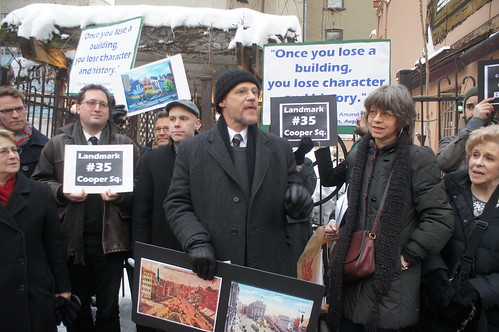
DSC05156Suzanne Rozdeba David Mulkins, chair of the Bowery Alliance of Neighbors, speaks at a demonstration this evening in support of a landmark designation for 35 Cooper Square. The designation would prevent development at the site.
1.28.11 Rally, 35 Cooper Square, East Village

Holding signs that said “Build Memories, Not Luxury Hotels” and “Save Cooper Square’s Oldest Building,” about 100 people, many of them East Village residents, gathered in front of 35 Cooper Square today in a rally supporting the designation of the site as a historic landmark.

“We’re here today because this is one of the most significant buildings on this street. This is the oldest building on Cooper Square. If you lose this building, Cooper Square loses a much earlier sense of its history,” David Mulkins, chair of the Bowery Alliance of Neighbors, which organized the rally, told the crowd, which included a handful of children from The Children’s Aid Society holding a sign that said, “Make 35 Cooper Square a Landmark.” The rally, which started at 4:30 p.m., lasted about 45 minutes.

The alliance is circulating a petition asking for supporters to urge the Landmarks Preservation Commission to designate the site as a historic site; more than 700 signatures have been collected so far. The building was sold for $8.5 million in November.

Mr. Mulkins, holding a sign with pictures of Cooper Square from the late 1880’s and early 1900’s, mentioned the site’s next-door neighbor, the Cooper Square Hotel, saying, “If we have this kind of out-of-scale, out-of-context development, we are destroying the sense of place that we get in these historic neighborhoods.”

The building at the current site, which houses the popular Cooper 35 Asian Pub, has a rich history that should not be destroyed, said State Senator Thomas K. Duane, whose 29th District includes the East Village. “There’s so little left of our beloved Village, of the history we are proud of. To risk losing a piece of that, even just one building, is tragic. We need the Landmark Commission to get this building on the calendar, and we need to preserve it.”

Assemblywoman Deborah J. Glick, who was also at the rally, said,  “We will continue to fight to landmark this essential part of New York’s history. I believe that people raising their voices will overcome the attempt of the administration to ignore us. Today is a great representation that we are standing together. We will fight until we win.”


A Magazine Rooted In The East Village


Created with Admarket’s flickrSLiDR.

Over the years, contributors to the political publication World War 3 Illustrated have created art and written about 1980’s guerilla war in Central America, the demonstrations that disrupted 1999 meetings of the World Trade Organization in Seattle and the ravages visited upon New Orleans in 2005 by Hurricane Katrina.

But the geographic entity that features most prominently in the history of the publication is the East Village. That is where the artists Seth Tobocman and Peter Kuper came up in 1980 with the title World War 3, which was based upon the idea that the United States has been involved since the Cold War in a nearly constant string of military conflicts.  (Armed warfare and civil unrest are not the publication’s sole subjects: “WW3 also illuminates the war we wage on each other and sometimes the one taking place in our own brains,” its website notes.)

Mr. Tobocman, who has participated in exhibitions at ABC No Rio and the Museum of Modern Art, lives to this day in the East Village.  So do several other World War 3 contributors like Mac McGill, Fly, and James Romberger.  It comes as little surprise, then, that stories and images related to the neighborhood play a significant part in a World War 3 retrospective at Exit Art called Graphic Radicals that runs until Feb. 5.
Read more…


At Porchetta, Doing One Thing Well

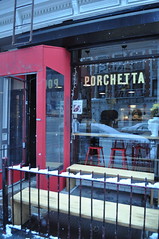
DSC_0204Meredith Hoffman Porchetta, 110 East Seventh Street.

The supreme realization, or maybe the reductio ad absurdum, of the East Village nano-scale restaurant is the place which serves only one item, and has no room to do anything other than order that one thing. In this regard, I would say that the echt East Village establishment is Porchetta, a shoebox at 110 East Seventh Street, between First and A. It is at least theoretically possible to eat something there other than porchetta – a roast pork sandwich – though it’s hard to see why you would; and you can squeeze onto a stool at the counter, though you’re liable to get trampled by the foot traffic if you do.

What is porchetta that one should make so much of it? Sara Jenkins, the founder, owner and master chef, explains that, in classic form, porchetta is a whole, slow-roasted pig stuffed with herbs and innards, and then encased in its own belly to produce a rich outer layer of crispy fat. Porchetta is street food, and served only in the form of a sandwich consisting of a thick slab of pork and its surrounding fat.
Read more…


The Day | Once Again, Digging Out

The ObserverRachel Citron

Good morning, East Village.

Another inch of snow is on its way, according to Accuweather, but with the mountains of white out there already, we may not even notice. If you’re sick of the weather, check out the nation’s 5 coldest cities for consolation. Number 1, according to the Weather Channel? Barrow, Alaska. Its population is a tenth that of our neighborhood, but nearly half their days are below zero, and think of how few cafes they have for respite from that cold.

Apparently, the snow won’t deter East Village activists, with two demonstrations planned – a rally at 4:30 this afternoon to protest planned development at the historic 35 Cooper Square and a picket tomorrow night at 8 over allegations of bias at the Continental bar.

Also out in full force will be 3,000 volunteers counting the homeless throughout the city, this Sunday night with HOPE NYC, the Homeless Outreach Population Estimate.

Who else will be winding through the snow-swirled streets? Well, DNAinfo suggests, red-tailed hawks are actually on the rise, and may just be the answer to our rat predicament.

If you’re looking for local – indoor – activities, you may want to tuck into the Bowery Poetry Club Sunday for David Amram’s 80th birthday celebration. Mr. Amram, a noted musician and author who performed with the likes of Jack Kerouac, will be performing at 8 p.m.


Viewfinder | Snowed In

A slideshow of images of today’s snowstorm by NYU Journalism’s Suzanne Rozdeba and community contributor J.B. Nicholas.

Created with Admarket’s flickrSLiDR.


Across the East Village, Snowbound

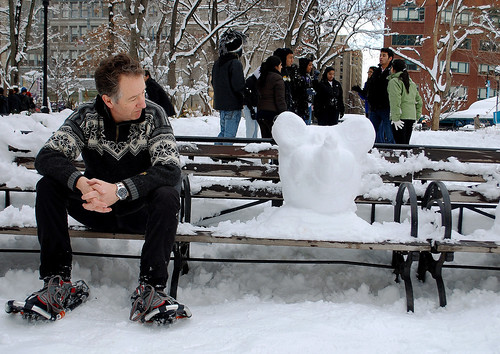
EV snowy carsGloria Chung After yet another big snowfall, residents of the East Village shoveled, played and improvised their way through the day.

Once again the snow has put a wrench in the daily lives of East Villagers. The subways are slow, the corners are drenched in slush, and so are our shoes.

In light of all this immobility, we thought we’d ask some of the people most directly affected by the weather – retailers feeling the effects of meager foot traffic, school children with a suddenly free day and older East Villagers – to weigh in on how the snowy tundra is affecting their lives.

Here are a few snapshots from a snowbound Thursday:

Meltzer Towers Senior Center

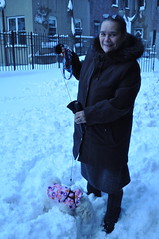
DSC_0215Meredith Hoffman Mary Williams and Lulu, a Maltese puppy, prepare to brave the elements.

Holding her heart-fleece coated Maltese pup, today Mary Williams walked into the bustling lobby of the Meltzer Towers Senior Center and shared news from the outside world’s snowy craters.

“Don’t go out the back — the snow went up to my knee!” Ms. Williams, 68, warned the other residents of the center, a public housing building on First Street and First Avenue. Despite the “awful day,” Ms. Williams had taken her dog, Lulu, out to play, because “we love the snow.”

But Ms. Williams’ fearless spirit was unmatched in most other residents, who said the inclement conditions would confine them to their building all day. And with even boisterous twentysomething’s falling in muck on street corners, who could blame older East Villagers?

Another resident sitting in the lobby of the senior center, Iris Sweiberg, 68, shivered with her back to the snow and recalled her 6 a.m. excursion outdoors as if it were an intrepid adventure.

“Everything was dark,” Ms. Sweiberg said. “I thought I was going to fall, it was so slippery.” Ms. Sweiberg had walked to the subway in an attempt to get to her job at the Medicaid building on 34th Street and Eighth Avenue. Since the trains weren’t running, she’d returned home, for a holiday — without pay, she lamented.

Perhaps Maria Montalvo, an East Village resident who slowly made her way down East Sixth Street this morning, said it best.

“When I see this kind of weather, I say ‘I want to go back to Puerto Rico!’”—Meredith Hoffman
Read more…


Scenes From A Snowy Day

The members of The Local East Village Flickr Group share their images of yet another snowy day.

"Yes It's Another Snow Storm" Snow Storm After-PartyKelly Samardak

Read more…


The Day | A ‘Thunder Blizzard’ Returns

EV bike in snow3Gloria Chung

Good morning, East Village.

In what EV Grieve dubbed “The Great Thunder Blizzard of 2011,” we were only one inch away from getting the 20 inches of snow that blanketed the city in the Dec. 26 blizzard. NY1 reports it’s our snowiest January ever, our sixth snowiest winter, and the eighth largest storm in city history. This time, “We were ready for it,” Michael R. Bloomberg told NY1 this morning after declaring a weather emergency last night. Grieve has some great neighborhood photos of the storm, including a snow-covered Tompkins Square Park, a fallen tree at East 10th Street and Second Avenue, and a downed awning at Kafana on Avenue C.

Brooklyn-based emcee Saigon has been out volunteering at the Bowery Mission the last few days, handing out blankets to the homeless, according to Bowery Boogie. Over on Avenue D, the homeless were bracing for the snow, as we reported yesterday.

If you’re off for the day and down for some sledding, Gothamist has a list of the best places to get your sled on.

After working up an appetite in the chill, head over to Ray’s on Avenue A and try his new roast beef on rye sandwich for $5. Nadie Se Conoce has a photo that’ll make you drool. Or, head out for some brunch since, surprise, surprise, according to Crain’s, New Yorkers love brunch more than residents in any other metro area.


A Restaurant’s Plea: Yes, We’re Open

Cucina Di PesceSuzanne Rozdeba Nick Alija, manager of Cucina Di Pesce, says that the perception by some neighborhood residents that the restaurant shut down after a fire earlier this month has cut business by about 40 percent. Below: Mr. Alija with a few patrons at the half-empty restaurant Tuesday night.
Cucina Di Pesce

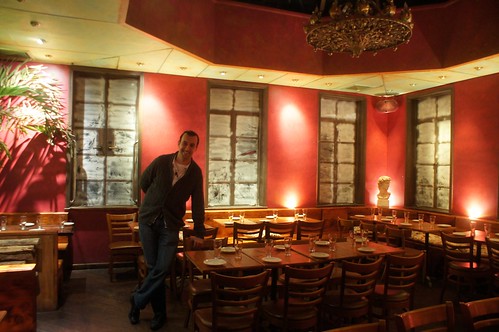
It was 9 p.m. on Tuesday night, and Nick Alija looked out at the half-empty dining room at Cucina Di Pesce and shook his head. Five tables were occupied, surrounded by space heaters pumping out warmth into the restaurant, which was damaged by a Jan. 4 fire that roared through the building next door.

Mr. Alija, a manager at the restaurant, knows that the damage could have been far worse. The East Village Farm & Grocery, where the fire started, was gutted. While Cucina was spared that fate – and has been able to remain open despite needing thousands of dollars in repairs – it has found itself stuck in a kind of commercial limbo: it is open for business but many people think it has shut down.

“I’ve heard people standing outside the restaurant saying we’re closed down, and have seen people online writing the same – and it’s not true,” Mr. Alija, 31, told The Local. “I’ve been telling people we are definitely open. It’s been a nightmare.”
Read more…


On Ave. D, Homeless Brace For Snow

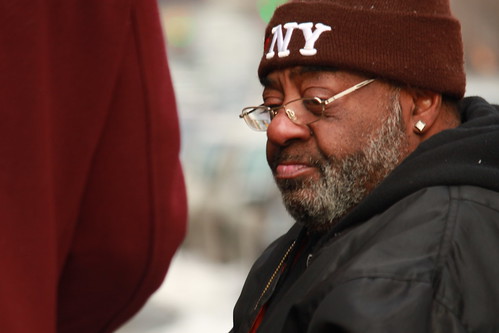
Homeless on Avenue D IChelsia Rose Marcius Felix Gates, 57, shoveled stranded motorists out of snow piles during December’s snowstorm. For many of the East Village’s homeless, the inclement weather can bring new opportunities to make money by performing odd jobs.
Homeless on Avenue D II

Snow for the homeless of Avenue D is a mixed blessing. They can earn quick cash shoveling out stranded motorists, but it is not enough to get them off the streets.

Take Abraham Rosado, for example.  Mr. Rosado, who’s 56, has earned money during winters on Avenue D by shoveling snow. To keep warm, he seeks out sidewalk grates and liquor stores.

It is a wearing routine when the temperature dips below freezing and, according to AccuWeather.com, Mr. Rosado will have more such days to endure. The last week of January is forecast to include a few more days of snow and possible rain with little sun.

That means Mr. Rosado may make a small profit wielding his shovel. But it also means that the only sustained periods of relief from the outdoors that he will likely be able to count on will come during dinner hours at a local soup kitchen.

Many of Alphabet City’s homeless helped commuters last month plow through piles of snow in exchange for a small fee.

Others like Shea Darnell Belle, 30, a homeless man born in the East Village, said they offer assistance for free, or next to free.

“One lady had me shovel out her car,” he said. “She asked, ‘What do you charge?’ and I said, ‘What you can afford.’”

Felix Gates, 57, who sells cigarettes on the corner of Avenue D and Ninth Street, watched during the late December blizzard as some motorists struggled to restart engines that sputtered and stalled. Some of those people left their cars unattended for a few days until the snow was cleared. Their misfortune ended up providing a boon to some homeless men and women who managed to get inside the vehicles and use them as temporary shelters.

Others, of course, slept outside, even in frigid temperatures.

“Many of them sleep on the steps, on stairways before the police tell them to go to a shelter.” Mr. Gates said. “You see people move from one spot to another, just trying to stay warm. I’ll be glad when it’s all over.”


The Day | Blizzards and Borscht

EV tompkins sq park snow9Gloria Chung

Good morning, East Village.

In case you haven’t had enough of the snow, we’re getting dumped on again now and expecting up to five inches. Look on the bright side – it’ll turn into a messy mix of sleet and ice by the end of the day, reports NY1.

Meanwhile, Community Board 3 has unveiled its State Liquor Authority agenda for a Feb. 14 meeting, where Superdive, a troubled bar on Avenue A, will ask for a renewal of its liquor license, Momofuku Milk Bar, on Second Avenue near East 13th Street, will request a new liquor license, and Ninth Ward, on Second Avenue between 11th and 12th Streets, is applying for a sidewalk cafe. If you want to join in the fun, the meeting will be held at the JASA/Green Residence on East Fifth Street at 6:30 p.m.

If you’ve got pierogies and borscht on the brain, run over to the Veselka kiosk at First and First. There’s a strong possibility the little Eastern European spot will be turned over to the city’s Parks Department after the owner, Tom Birchard, expressed concern over a costly requirement to install a bathroom, according to Crain’s.

Take a nostalgic look at the East Village in the late 80’s, with pics on EV Grieve, and of the Lower East Side from the 60’s to the 80’s with photos at 21-7 magazine.

Got rats, bedbugs or cock roaches? A company called Optomen Productions is looking for tenants with severe infestations for a new documentary, according to Bowery Boogie. They’ll take care of your pest problem, free of charge.


After a Theft, a Street Artist Speaks

Adam Cole a.k.a. CostDale W. Eisinger
aDSC_0774Jenn Pelly Adam Cole, the reclusive street artist who is also known as Cost, and the newspaper distribution box that he designed. The box was stolen from a street corner and Mr. Cole played a role in its recovery.

In the early 90’s, Adam Cole, a.k.a. “Cost,” hit the streets undercover. As one half of the now-mythic graffiti duo Cost and Revs, he was busy revolutionizing the graffiti world and catapulting the wheatpasting medium to an international street art phenomenon. According to Mr. Cole, he and Revs were wanted by the NYPD. He wore a mask in photographs.

In 2010, Cost’s life is different. After remaining largely quiet since a graffiti-related arrest in the mid-90s, he heads to Mars Bar for a recent interview — on the theft and recovery of his most recent work — in a Porsche. Over noontime beers, Mr. Cole explains he has done “okay” for himself with “honest work” as a small business owner. “I don’t want to run from the law anymore,” he says, each word’s articulation recalling his home borough, Queens. As one of New York City’s most infamous and enigmatic street artists, Mr. Cole found himself, in December, chasing after a thief himself.

Described by Cost as a “professional street art thief,” that Brooklyn-based criminal stole, a carefully crafted newspaper box Mr. Cole created for Showpaper, a free newssheet of all-ages DIY concert listings distributed throughout the city. The box was Cost’s largest public artwork since his mid-90s arrest, and hit Second Avenue at Houston Street one Monday last November. By the Thursday evening, it was stolen, and immediately posted on eBay with a $4,000 price tag. The box has been off the streets since—but after being recovered by project curator Andrew Shirley in December, it will return to the East Village in coming weeks.

When it first hit the East Village, the box was loaded with rocks and concrete, but Mr. Shirley, also at our Mars Bar meeting, was not surprised by its theft. “We dropped the box off around two in the afternoon, and as we drove back down First Avenue, that day, I didn’t even expect to see it then,” Mr. Shirley said. “I didn’t think it would last a day.”

“The thief represents society to me,” Mr. Shirley said. “Society is all about money —capitalism, and making a buck. The thief took the joy and purity out of the project.”
Read more…


The Best East Village Dive Bars

Mars Bar, East Village, New York City 10Vivienne Gucwa

When I walked into Mars Bar for the first time I immediately noticed the smell. It was more of a stench, the same odor that permeates my yoga studio after a crowded Bikram class. The second thing I noticed was the man next to me at the bar, who pulled out a deli-bought sub from a paper bag. After a few bites, he ordered a Budweiser from the bartender. Mars Bar does not serve food. Even so, the bartender was remarkably nonchalant about the customer who was halfway through his dinner.

The establishment has been tirelessly documented as a quintessential New York City dive bar — a remnant of an East Village before the Bowery accommodated luxury hotels. Its graffiti-adorned walls, scrawled with disparaging phrases like “Die, Yuppie Scum,” take aim at the shiny high rises and condominiums popping up at an alarming rate.

Now, as Mars Bar prepares to close its doors for at least the next two years – and perhaps longer – it seems like an appropriate time to take a step back and assess the East Village’s best dive bars before they close for good.
Read more…


The State of East Village Hip Hop

Chaz KangasChaz Kangas.

Passing by the corner of Second Avenue and Fifth Street on a Monday night has become quite a different experience in the three months since Sin Sin closed. The former home of Freestyle Mondays, the vibrant, laidback epicenter of one of the country’s longest lasting hip hop scenes, now sits in silence with the tinted windows whispering to passersby about parties past. Sometimes I’ll even stop in front of the windows and peer inside for a brief moment of nostalgia. When I do this for more than 10 seconds, a local resident will approach and say something to the effect of “that place is closed, the party is over.” While it’s hard to deny the first half of that sentence, the latter portion couldn’t be more wrong.

For many involved in the East Village hip hop scene, “Freestyle Mondays” is the center of our musical solar system, and it would take more than an eviction notice to eclipse such a brightly shining community. When it was announced that Sin Sin would be closing last October, there was tremendous interest from different venues offering to inherit the event and keep things continuing as usual. Eventually, hosts iLLspokiNN and Mariella chose Bar 13, (13th and University) as Freestyle Mondays’ new home. Since then, even amid the numerous snowstorms, the loyalists have returned.

But this move doesn’t mean a complete migration of hip hop from the East Village. Brown Bag Thursdays, a bi-weekly rap showcase at Voodoo Lounge (First Avenue and Second Street), is currently in its second year and is becoming something of a landmark for rap enthusiasts to visit.

Organized by local favorite rhyme collective the Brown Bag All Stars, the event has become one of the area’s premiere hip hop attractions, pairing local acts back-to-back with independent rap artists from all over the continent. This international appeal has resulted in events such as last December’s benefit for the family of Minneapolis rapper Michael ‘Eyedea’ Larsen who died suddenly in October. It’s this outreach and togetherness that exemplifies what makes the scene so special as Brown Bag Thursdays joins long-running hip hop open mic End of the Weak (Sunday nights at Club Pyramid on Avenue A) as another staple in keeping the underground rap scene in the East Village alive. In a genre with an ever-changing sound, perhaps it’s fitting that the walls surrounding it change too.


Chaz Kangas writes about the hip hop music scene at his blog.


The Day | A Blizzard’s Cost

Phillip Kalantzis Cope

Good morning, East Village.

This morning began with the sight of fresh snowflakes and also a reminder that no matter how pleasing the sight may be to many eyes, it also can also come with a cost. The Times reports that city officials have put the pricetag for cleaning up last month’s blizzard at about $68 million.

EV Grieve has a full report about one of the season’s most vivid reminders of the severity of the recent temperatures: efforts to free a car that was frozen under a sheet of ice when a water main burst on East Second Street. An image of the car also made the front of The Post.

Two development projects are also being discussed in the blogosphere. Grieve has more on an effort to stop development at 35 Cooper Square (including a look at the building and its neighbors from 2004). And turning our gaze a bit south of the neighborhood, Bowery Boogie has a report on Community Board 3’s passage of new guidelines for development of the Seward Park Urban Renewal Area – an agreement years in the making.


Reflecting on East River Park Delays

East River Park Suzanne Rozdeba The East River Park is the focal point of an unrealized plan for a unbroken protected greenway on Manhattan’s east side. Below: The park, renamed for former Mayor John V. Lindsay in 2001, is also a hub for runners and cyclists.
East River Park

Before the construction of the East River (later FDR) Drive and the public housing along the east side of the street, Avenue D’s relationship with the East River was much more direct than we see now. When the area was still dominated by an active industrial waterfront, almost every east-west street in the neighborhood flowed directly into the river. Today, only a couple of those streets give access to the waterfront and the FDR must be traversed first.

Indeed, a quick look at some historical photographs and maps shows that the water was physically much closer to Avenue D than it is today. For instance, if you stood on the corner of 13th Street on Avenue D in the 1930’s, you could look directly at the water lapping up against the dock, while today that view is dominated by a power plant. Meanwhile, a walk from the corner of East Sixth street and Avenue D would deliver you to the water’s edge after approximately 900 feet, and the equivalent walk today is about 350 feet longer.

The difference, of course, is due both to FDR Drive and the East River Park (renamed John V. Lindsay Park in 2001). What the neighborhood lost in direct access to the water, it gained in additional open space. In fact, it gained Manhattan’s biggest open space south of 59th Street. The park, which is almost 60 acres in size and stretches from East 12th Street to Montgomery Street, owes its origins to the FDR Drive and Robert Moses, the man behind almost every piece of serious infrastructure conceived and/or constructed between the Great Depression and the city’s financial crisis of the 1970’s.
Read more…


From CBGB to Community Editor

Colin MoynihanColin Moynihan.

Although I was born in Manhattan my first trips to the East Village came as a teenager in the 1980’s when I traveled to the Bowery – CBGB! – and to St. Marks Place, where I spent hours in used record stores and book stores.

Later, in the early half of the 1990’s, I moved to Suffolk Street, a few blocks below what is generally considered the southern end of the East Village, although I always tended to consider the territory above East Houston Street to be the northern zone of the Lower East Side. (There will be more, in future posts, on the nature of geography and labeling of neighborhoods.)  I have lived just south of Houston since then, but my travels and my interests have always extended beyond that borderline.

In the late 1990’s I began writing newspaper stories about the area and it was then that I began to see events not so much in terms of what they meant to me but in terms of how they affected others and how they fit into a historical or cultural context.  Some of my first stories were about local landmarks, squats, the struggles surrounding the future of the Charas / El Bohio community center, the community gardens – during both celebratory moments and times of tension – and the nearly ceaseless battles over real estate and development that have shaped so much of the recent history of the East Village and continue to do so today.  (More, also, in future posts, on that.)

Over the last eight years, I have reported and written more and more about the world beyond the East Village.  But I have never stopped roaming the neighborhood, talking with people and paying attention to what is going on there.

I have also continued to write about the East Village: The departure of a market, a cafe, or a large, eccentric piece of public art; the possibility of privatizing public space; the troubles faced by a mainstay of the local landscape; the tradition of protest and debate; the death of a neighbor and existence as it is experienced on a certain stretch of Avenue A.  To me these are not just interesting stories.  They are narratives of vital concern to the people who cherish the neighborhood’s streets and parks and buildings and sense a connection to the other lives that are lived here. I know that I am not the only one who feels that kinship.

I’m fortunate to be able to start off in this job with the benefit of a solid base established by my predecessor, Kim Davis and the site’s chief editor, Richard G. Jones. (Kim and Rich, thank you.)  And I’m hoping to help continue making The Local a site where people go to read about –– and to write about –– the events and occurrences that make life in the East Village something worth caring about.

To all contributors: I look forward to working with you.  And to all members of the community: consider this an invitation to become a contributor.


Colin Moynihan is the community editor of The Local East Village. If you are interested in becoming a contributor to the site, please email him.