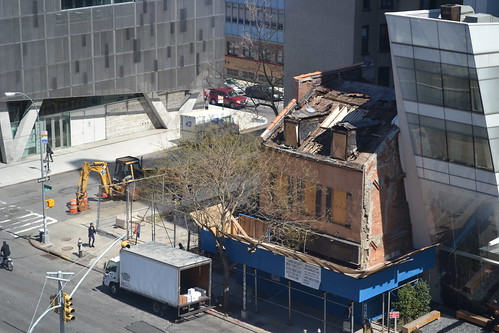
 Ian Duncan The author, one of the preservationists trying to forestall the demolition of 35 Cooper Square, issues a call to the developer of the site to cover the roof to prevent further damage. Below: A detail of the roof shortly after work began in February.
The recent article, “Developer Cited for 35 Cooper’s Roof” had some readers curious re what’s so important about the roof. The history of this building has been well-told, but the roof and dormers as essential structural elements and character-defining features, are currently compromised by partial demolition and exposure to the elements. Any effort to save this building, at this point, needs to start with the basics: putting a tarp back on the roof.
Over the winter, roofing material was removed by workers hired by the new owner under a permit for asbestos abatement, a prerequisite for obtaining a demolition permit. The dormers were similarly stripped of their protective roofing, and non-historic skylights were removed, exposing not only the roof structure but the upper floors of the building to the elements. The old wooden shingles, part of the historic fabric of the building, are now visible, but so too are the gaping holes in the roof. The rain and snow of the past few months are surely accelerating any decay and rot in the 185-year-old structure smacks of demolition by willful neglect.
Read more…
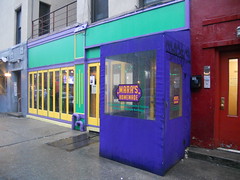 Elizabeth Vulaj The owner of Mara’s Homemade, who recently announced that the restaurant is closing its doors, cited bike lanes that were installed last summer as part of the reason that the restaurant saw a decline in business.
Taxes and the rent have gone up but Mara Levi mostly blames the bike lanes for having to close Mara’s Homemade, her authentic New Orleans-style restaurant on East Sixth Street near First Avenue. If the customers come from all over the tri-state area and even beyond, she said, a restaurant has to have parking.
Ms. Levi said that she now pays double for taxes than she did when she opened seven years ago, but that the addition of the bike lanes, which opened in July and reduced the number of available street parking spaces, have significantly contributed to the business’ decline.
“We saw a drop in business the day those lanes came in,” said Ms. Levi. “When you go from twelve parking spaces per block to three, that makes a difference.”
In January, Mayor Michael R. Bloomberg conceded that city officials should have notified residents when they decided to install the lanes. Levi said she was not even aware of any plans until one evening, where she saw construction workers toiling away on First Avenue.
“One night we come out, and they were marking lanes and paving,” said Ms. Levi. “It was a total surprise. There was no input from the community and it upset me a lot.”
Read more…
 Michelle Rick
 Good morning, East Village.
It’s Good Friday. CBS New York has word of an Easter egg walking tour – walking tour meaning ‘hunt’ but less frenzied and with a knowledgeable guide rather than cryptic clues. The jaunt will include chocolate pizza at Max Brenner and a stop in at Black Hound.
It’s also Earth Day. In the spirit of things, EV Grieve published the announcement that the St. Mark’s Church Greenmarket at East 10th Street and Second Avenue will return for the summer May 3.
NYU Local has an interview with a dope dealer at the school. According to the post business is good, despite the highly publicized bust of a Columbia University drug ring and its East Village supplier late last year.
Blockshopper reports that political consultant John Del Cecato has bought a condo in the neighborhood. Mr. Del Cecato, an associate of former presidential advisor David Axelrod, was obviously not put off by Chico’s Barack Obama mural becoming instead a plain blue wall covered in tags. Perhaps most interestingly, the Blockshopper post adds that 71 East Village condos have been sold in the last 12 months at an average price of $750,000.
Among a flurry of preservation news, DNAinfo reports that the Landmarks Preservation Commission is considering a new historic district in the neighborhood. It could include up to 300 buildings in an area bounded by East Second Street, Bowery, East 10th Street and Second Avenue. The commission will hold a meeting for property owners on April 26.
As for the weekend’s weather forecast: Today a high of 55 degrees with some clouds, Saturday 62 degrees and wet with more of the same on Sunday. Not the nicest, but try to enjoy yourselves.
This post has been changed to correct an error; an earlier version misidentified the greenmarket that is opening next month.
The developer of 35 Cooper Square has resolved three outstanding code violations concerning work at the site, according to a spokeswoman with the Department of Buildings. The developer, Arun Bhatia, paid about $16,000 in fines related to the violations, according to department records; the status of a fourth violation was unclear. Mr. Bhatia has not said how he intends to develop the site, which preservationists have asked him to maintain. —Suzanne Rozdeba
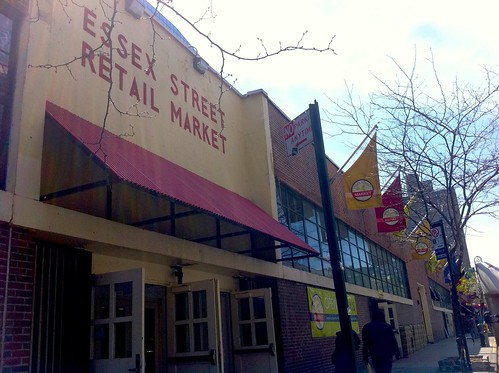 Suzanne Rozdeba Preservationists have rallied around the Essex Street Market, which may be forced to move because of the Seward Park Urban Renewal Area development project.
While a battle between preservationists and the developer of 35 Cooper Square is still brewing, residents on the Lower East Side are raising their voices about the possible uprooting of another historic location, the 70-year-old Essex Street Market.
“If that market had disappeared, and I had just sat back in my apartment, I don’t think I could live with myself,” said Cynthia Lamb, a Lower East Side resident who is circulating a petition to keep the market, home to more than 20 businesses, from being relocated as part of the contentious Seward Park Urban Renewal Area project. The site is home to five parcels of land that have sat empty as a development debate has steeped for over 40 years. John Shapiro, the city’s planning consultant, has suggested a “superior location” elsewhere on the Seward Park site for the market.
Read more…
 Mario Ramirez
 Good morning, East Village.
Neighborhoodr spotted a Seventh Street and Second Avenue subway stop in the new Atlas Shrugged movie. The adaptation of Ayn Rand’s famous novel is set in 2016, by which time the Second Avenue subway should be completed, but in real life it will stop at 14th Street and Houston, bypassing the East Village entirely.
Until then, the most rapid form of transport might be the bicycle. But watch out, one EV Grieve reader sent the blog a copy of a $270 ticket he was given for running a red light on his bike.
Grieve also brings word that an apartment has been rented out in 120 St. Marks Place. The address is the former site of the Cave artist’s commune and was home to the Mosaic Man. A developer eventually removed the squatting artists in 2006.
DNAinfo has mapped out bedbug complaints for the first three months of the year. The Community Board 3 area, which includes the East Village and the Lower East Side, got off relatively lightly with only 4 violations and 27 complaints. Compare that with Community Board 9 on the far Upper West Side, which had 30 violations. Bowery Boogie notes that Discovery Channel show Human Planet will take a look at Lower East Side rats this weekend. According to the show, rat-related complaints are up 9 percent so far this year.
There’s more from The Lo Down on the 7th Precinct’s crackdown on troublesome Lower East Side revelers. But 102-year-old Lillian Sarno probably isn’t among their number, though. According to the Post, Ms. Sarno was at Back Room last weekend for a birthday tipple. The faux-speakeasy stands on the site of a real speakeasy she visited 78 years ago to celebrate passing the New York bar exam.
The weather? A high of 57 degrees and mostly sunny, so a fine day indeed.
Despite the impending arrival of upscale Brooklyn chain Union Market, finding good quality food in East Village supermarkets can be difficult.
Health and nutrition coach Magdelena Wszelaki, who runs tours of supermarkets, offers some advice on what to look out for at Key Foods on Avenue A and East Fourth Street.
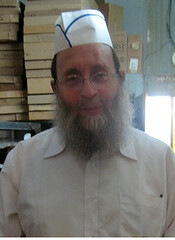 Carolyn StanleyMoishe Perl.
“What, no bread? Nothing?” balked one customer upon entering Moishe’s Bake Shop Monday afternoon, greeted by bare bread cubbies and stark glass cases typically teeming with doughy Jewish treats. “What’s going on here?” another disappointed patron wondered aloud, stumbling out of the empty store.
But for many regulars of Moishe’s on Second Avenue near East Seventh Street, the shop’s temporary transformation is nothing new, and certainly no cause for alarm. The bakery, which locked its doors on Monday in observance of the Jewish holiday Passover, will reopen at the end of eight days, in accordance with Kosher law.
So why does Jewish law forbid bread during Pesach, and what does Moishe Perl do when he’s not allowed to bake? The Local met up with Mr. Perl hours before sundown and the first night of Passover to find out.
Q.
Why does Moishe’s Bake Shop and other Jewish bakeries shut their doors during the Passover holiday? You’re required to remove all of the Chametz, or leavened products, right?
A.
As you know, the Israelites were slaves in Egypt for 210 years, and the Pesach holiday, and its meals, are in remembrance of that. According to the bible, when the Israelites finally left Egypt during the Exodus, they were in a hurry and had no time for their bread to rise. Today, to remember their journey, Jews eat unleavened bread, called Matzah, and to follow Kosher law, we clean everything of Chametz. The shop bakes Chametz, so we spent all last night and this morning cleaning out everything, and at home we do the same. We’ve been preparing for the holiday for weeks.
Read more…
Mariko Osanai cupped her cell phone away from her mouth and whispered “Just one second, I’m on the phone with my sister in Japan – there’s been another big earthquake, and they’re having a blackout. Can you believe it?” She shook her head, visibly upset, and stepped outside Dlala salon on Avenue A to smoke a cigarette, taking deep drags and pacing as she listened to the news.
Weeks after the earthquake and tsunami that devastated Japan, Ms. Osanai, like many other Japanese living in the East Village, continues to spend much of her time on the phone, reaching out to friends and relatives from the hard-hit coastal regions.
But for Ms. Osanai and a handful of Japanese East Villagers, making phone calls is not enough. A group of local Japanese artists have designed a logo – emblazoned with the words “Love Save Japan” in capital letters – to draw attention to the crisis in Japan and which has already helped raise thousands of dollars for the relief effort.
Read more…
![P4180073[1]](http://farm6.static.flickr.com/5302/5634942718_c87c354563.jpg) Jesse Fish
Jesse FishThe East Village has historically been visited by and home to a diverse and eclectic variety of artists, musicians and writers. More than 50 years ago it was the domicile of the late drug-ingesting, drink-swilling gonzo journalist Hunter S. Thompson. In the winter of 1959 the 22-year-old Thompson listed his address as 69 East Fourth Street, a residence he shared with a friend.
According to Thompson’s letters in “The Proud Highway” (1997), the native Kentuckian befriended a number of Louisville expatriates while living in downtown Manhattan. Most of “them move in different circles,” he wrote to the editor of a hometown paper, ”and all of them have their own reasons for leaving.” Thompson wrote explained that his story would be “a single shot (Louisville Expatriates in New York) or a series of contrasting interviews.” New York City was not easy for The Good Doctor at this time and he had moved in and out of the area on occasion. While living in Greenwich Village a year before, Thompson wrote an unsolicited letter to a newspaper in British Columbia stating that he would be willing to “work 25 hours a day if necessary, live on any reasonable salary, and don’t give a black damn for job security, office politics, or adverse public relations.”
The erratic and spontaneous Thompson, who once stated that he had “no taste for either poverty or honest labor, so writing is the only recourse left for me,” bounced through a variety of neighborhoods and writing jobs in Manhattan during the late 1950’s and throughout the 1960’s. During this time he also briefly studied short story writing at Columbia University and wrote a novel, “Prince Jellyfish,” which remains unpublished. The work has been described as “an autobiographical novel about a boy from Louisville, going to the big city and struggling against the dunces to make his way.”
Despite his initial grappling as a young writer in the city, Thompson always had time and money for a few brews and one of his favorite haunts, McSorley’s Old Ale House, is within stumbling distance of the East Fourth Street address. Additionally, the Hell’s Angels New York headquarters are located near this residence on 77 East Third Street. This is interesting to note because Thompson’s first published book, “Hell’s Angels: The Strange and Terrible Saga of the Outlaw Motorcycle Gangs” (1966), was a non-fiction publication that Thompson penned while riding with the notorious biking gang in the early 1960’s. It is not known if Thompson ever visited their East Village hangout before the 1966 publication of the book, but the thought of a boozed up and downtrodden young Thompson asleep on the group’s bench outside does not seem incredibly far-fetched.
For those locals who took a quick glance at accident statistics for New York City compiled by Transportation Alternatives, it probably came as little surprise that the East Village is home to two of the city’s most perilous intersections.
The intersection of Third Avenue and East 14th Street tied for the fifth most dangerous intersection in Manhattan with 66 crashes involving pedestrians from 1995 to 2005.
Bowery and West Houston Street tied for the most dangerous intersection in the entire city with 29 crashes involving cyclists.
Now that Transportation Alternatives has unveiled a plan that it believes will help make streets safer, The Local decided to pay a visit to 14th Street between Second and Third Avenues to talk to residents and business owners about the area’s dubious place as one of the city’s most treacherous stretches of asphalt.
NYU Journalism’s Claire Glass reports.
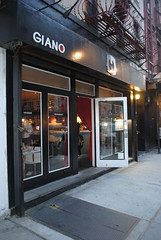 M.J. Gonzalez Giano, 126 East Seventh Street.
One morning not long ago, Paolo Rossi, the co-owner of Giano, an Italian restaurant at 126 East Seventh Street, was having his coffee when he was struck by an inspiration for “a new caprese for 2011.” The caprese is a classic Italian sandwich with tomato and mozzarella. Paolo is fond of the classics but also, as a worldly Milanese, of the newest of the new. The caprese of 2011, now available on Giano’s menu, would feature a basil-flavored soft bun wrapped around a paper-thin slice of tomato and buffala mozzarella ice cream.
After more than 10 years in New York, Paolo’s English is pretty good, but I thought I had misheard him. Ice cream? “It’s a ‘Wow’ effect,” Paolo explained. “I can ask Simone to make you one.” Simone Bonelli is Giano’s new chef. He had, Paolo proudly told me, “worked seven years next to the number six chef in Italy” and had recently left the terribly pricey Per Bacco to cook at Giano. It was the middle of the afternoon, and Simone had just arrived on his Vespa; his helmet, bright orange with a white racing stripe, was sitting on Giano’s curving, fan-shaped white bar. I felt like I had walked into a Fellini movie.
Read more…
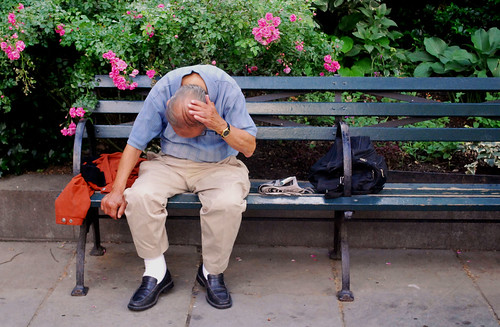 Rachel Citron
 Good morning, East Village.
It’s tax day. If you haven’t filed yet, better get down to the post office quick sharp. If that’s not encouragement enough, an EV Grieve reader spotted this friendly warning.
In better news, Passover begins at sundown. Last week, The Times reported on the growing trend of eating out for the traditional Seder meal. East Village spots JoeDoe and Octavia’s Porch will be offering their take, and JoeDoe co-owner Jill Schuster put together a playlist to remind guests of a old-fashioned family Passover.
Hot on the heels of incredibly popular Tompkins Square Park ping pong table, which has seen action from all ages, DNAinfo reports that the planned facelift for Dry Dock Park will include domino tables. The $1.2 million restoration will also repair dilapidated basketball courts and install better lighting.
EV Grieve notes that traffic lights on Cooper Square are new, after originally wondering if they had been covered as part of a prank. That will probably come as welcome news to anyone used to madly dashing across the Square in the face of buses and cabs coming from all directions.
And finally, The Times reported on Friday that the Hot Chicks Room sign that had so irked some residents will find a new home in a Governors Island chicken coup.
After a blustery weekend, things are looking up: highs of 60 degrees are in the cards today with a few spots of cloud. Have a good week.
C. Ceres Merry on stitching together compelling images in New York.
“The date 10/10/10 was the day of the online event called One Day On Earth. When I saw Land’s End LES I decided not to just snap a pic but take a photograph. I truly changed that day from just taking many quick snaps to seeing the city as collected works of art and really learning how to take better photographs.”
Read more…
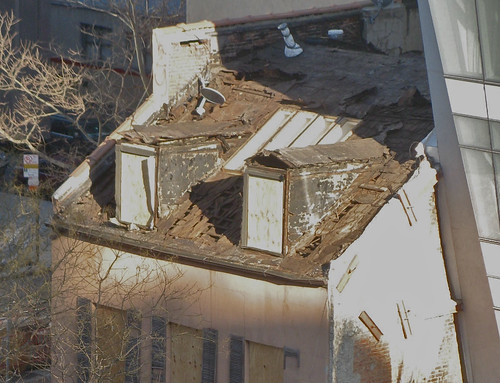 Tim Milk The developer of 35 Cooper Square has been cited by the Department of Buildings for the condition of the historic structure’s roof, which is pictured above in a February photo.
City officials have ordered the developer of 35 Cooper Square to take immediate steps to repair the roof of the historic structure, which has been the subject of a campaign by preservationists to keep it from being razed.
On Wednesday, officials with the Department of Buildings issued a citation to the developer of the site, Arun Bhatia, ordering him to make the repairs.
Since February, city officials have issued four citations concerning work at 35 Cooper Square, all of which are still open. In addition to this week’s notice regarding the roof repairs, Mr. Bhatia has been cited for failure to safeguard property, performing work without a permit, and failure to post a permit.
A spokeswoman for the Department of Buildings said that the citation regarding the roof repairs “means that we had previously issued a violation for the condition of the roof and the property owner has not corrected that condition. What the property owner should do now is obtain permits to perform the necessary roof work. In this case it would be to close off the roof.” A hearing on the roof violation is set for June.
Asked about the gaping hole in the roof and whether the developer would be required to cover it, she said, “We issued a violation for the roof. To bring the site into compliance, the owner should obtain a permit for the necessary work.”
A spokeswoman for Mr. Bhatia, who met with preservationists on Tuesday to discuss the building’s future, did not immediately respond to requests for comment.
We at The Local have spring fever. And as we scoured the streets for this week’s Street Style, we noticed that the warm weather is starting to take effect on fashion. Whether in the first shorts of the season, white denim or light jackets, plenty of East Villagers are taking hold of fashion’s ubiquitous denim and stylin’ it up for spring.